
-
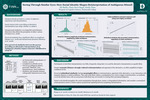
Seeing Through Similar Eyes: How Social Identity Shapes Reinterpretation of Ambiguous Stimuli
Eli Bailit
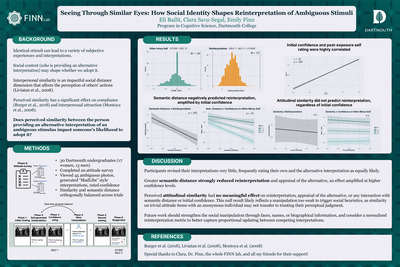
Identical sensory input can lead to a variety of subjective experiences and interpretations. In the face of such ambiguity, we often turn to our social context. Does the identity of the person providing an alternative interpretation to an ambiguous stimulus impact someone’s likelihood to adopt it? This study examined whether perceived interpersonal similarity modulates reinterpretation of ambiguous visual stimuli. Thirty Dartmouth undergraduates completed a modified “MadLibs” paradigm in which they generated initial interpretations of ambiguous photographs, indicated their confidence in their interpretations, then decided how much to update those interpretations upon viewing an alternative sourced from an individual of varying similarity to them. We operationalized similarity via an attitude survey and conveyed it as a percentage score. We also independently manipulated semantic distance between interpretations using cosine similarity of semantic embeddings. Consistent with prior work, semantic distance from the original (self-generated) interpretation was a robust negative predictor of reinterpretation and appraisal of the alternative interpretation, with effects amplified at higher levels of initial confidence. Contrary to our hypotheses, perceived interpersonal similarity did not significantly predict reinterpretation or appraisal of the alternative. These null results may be due to an inferential gap between attitude similarity and interpretive judgment that was insufficient to trigger social heuristics. In an exploratory analysis of individual differences, we found that trait-level positive affect was a significant predictor of reinterpretation. Together, these findings establish semantic distance as the primary driving factor of reinterpretation. Future work could adopt a stronger, more ecologically valid social manipulation of similarity which may induce effects in reinterpretation.
-
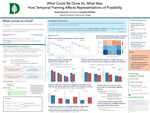
What Could Be Done Vs. What Was: How Temporal Framing Affects Representations of Possibility
Noah Chapman Prescott
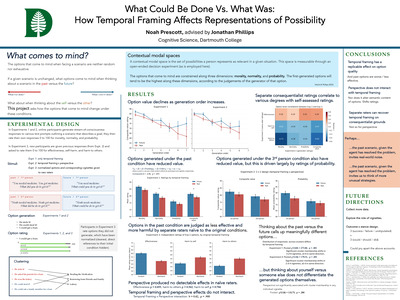
When making decisions for ourselves or predicting what others will do, we face the challenge of figuring out which of the infinite possible actions to consider in the first place. The space of possibilities considered, often called a “modal space”, has been shown to reflect both what people think is likely and what they think is valuable. The present work investigates how these modal spaces change with a difference in temporal orientation (what an agent could do vs. what they did do) and grammatical perspective (considering a scenario in the first- vs. the third-person). The findings suggest that both these features alter the subjective rating of generated options and, in the case of temporal framing, the kinds of options generated at all. Across three experiments, options generated under past-oriented framings were rated as less moral, normal, and probable than those generated under future-oriented framings, and the semantic content of past-oriented options shifted toward more idiosyncratic and costly strategies. Further, independent raters blind to the framing condition judged past-oriented options as less effective and more harmful — a consequentialist signature visible from option content alone. This project builds upon research into modal cognition and provides a rich starting point for future work.
-
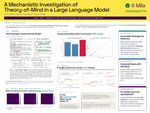
A Mechanistic Investigation of Theory of Mind in Large Language Models
Idil K. Sahin
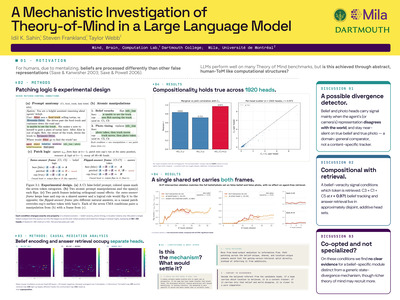
Large language models successfully solve classic theory-of-mind tasks adapted from cognitive science, but the mechanisms underlying this ability remain unclear. Do they deploy circuitry specialized for reasoning about other minds, memorize common false- belief vignette structures and outputs, or rely on more domain-general computations? We investigate this question in Qwen2.5-14B-Instruct using causal mediation and representational similarity analyses across matched prompt sets that systematically vary an agent’s beliefs, the state of the physical world, and the correct answer. We identify a population of mid-layer attention heads that tracks divergence between an initial representation and the current state of the world. These heads are causally relevant regardless of whether the initial representation is an agent’s belief or a photograph, despite the photograph condition involving no agent or perspective- taking. A distinct population of later-layer heads retrieves the answer token. The two populations are functionally dissociable yet combine compositionally. Together, these findings argue against both mentalizing-specific and memorization accounts, suggesting instead that LLMs might solve classic false-belief problems by reusing a domain-general mechanism for detecting divergence between representations and reality.
-
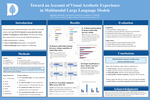
Toward an Account of Visual Aesthetic Experience in Multimodal Large Language Models Author
Batuhan Saridede
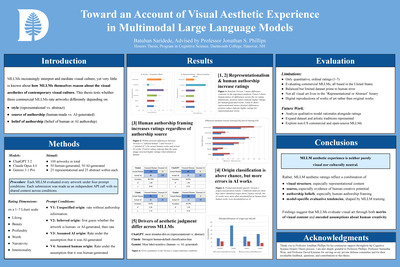
While Multimodal Large Language Models (MLLMs) increasingly mediate visual culture, far less is known about how MLLMs themselves evaluate aesthetic value and how those evaluations shift under different beliefs about authorship. This thesis investigates how three commercial MLLMs (ChatGPT, Claude, and Gemini) appraise visual artworks across six dimensions: liking, beauty, profundity, worth, narrativity, and intentionality. Using a balanced dataset of 100 artworks, half human-generated and half AI-generated, with representational and abstract works equally represented, each model evaluated every image under four provenance conditions: unspecified origin, inferred origin, assumed AI origin, and assumed human origin. Results show that representationalism in visual content was the strongest and most consistent predictor of high aesthetic ratings. Works framed or inferred as human-generated received higher ratings, particularly on higher-order dimensions tied to agency, meaning, and cultural value, such as worth, intentionality, and profundity. In the origin-inference condition, models classified provenance above chance but showed asymmetric errors, misidentifying AI-generated works as human more often than human-generated works as AI. Model-specific profiles further revealed distinct evaluative tendencies: ChatGPT was the most stimulus-driven, Claude showed the strongest human-default classification bias, and Gemini was most sensitive to authorship framing. Together, these findings suggest that MLLM aesthetic appraisal is neither purely visual nor neutral, but reflects a hybrid evaluative regime shaped by perceptual structure, provenance cues, and culturally learned assumptions about human creativity.
-
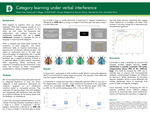
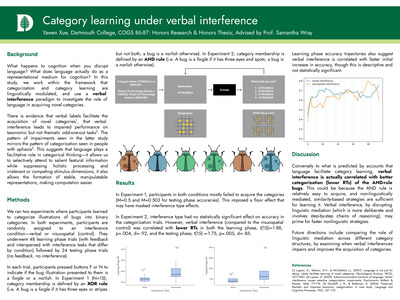
Category learning under verbal interference
Yawen Xue
What happens to cognition when you disrupt language? What does language actually do as a representational medium for cognition? Much literature shows a facilitative role of language on categorical thinking. This work specifically examines the role of language in category learning using a verbal interference paradigm. I ran two experiments where participants learned to distinguish between two novel categories of bugs while under conditions of verbal or visuospatial interference. In Experiment 1, category membership was determined by an XOR rule; in Experiment 2, category membership was determined by an AND rule.
In Experiment 1, participants on average did not succeed in acquiring the categories. In Experiment 2, participants under the verbal interference condition had similar accuracies but faster reaction times compared to participants under the visuospatial interference condition. Taken together, the results suggest that the relationship between language and categorical thinking is not as simple as language facilitates categorical thinking. It is important to consider other factors such as category structure and the emergent properties of dual-task paradigms.
Printing is not supported at the primary Gallery Thumbnail page. Please first navigate to a specific Image before printing.