

Files
Download Full Text (1.3 MB)
Description
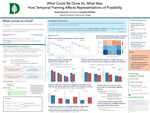
When making decisions for ourselves or predicting what others will do, we face the challenge of figuring out which of the infinite possible actions to consider in the first place. The space of possibilities considered, often called a “modal space”, has been shown to reflect both what people think is likely and what they think is valuable. The present work investigates how these modal spaces change with a difference in temporal orientation (what an agent could do vs. what they did do) and grammatical perspective (considering a scenario in the first- vs. the third-person). The findings suggest that both these features alter the subjective rating of generated options and, in the case of temporal framing, the kinds of options generated at all. Across three experiments, options generated under past-oriented framings were rated as less moral, normal, and probable than those generated under future-oriented framings, and the semantic content of past-oriented options shifted toward more idiosyncratic and costly strategies. Further, independent raters blind to the framing condition judged past-oriented options as less effective and more harmful — a consequentialist signature visible from option content alone. This project builds upon research into modal cognition and provides a rich starting point for future work.
Publication Date
6-14-2026
Dartmouth Digital Commons Citation
Prescott, Noah Chapman, "What Could Be Done Vs. What Was: How Temporal Framing Affects Representations of Possibility" (2026). Cognitive Science Senior Thesis Posters. 1.
https://digitalcommons.dartmouth.edu/cogsci_thesis_posters/1

Comments
This poster is summarizes the author's senior thesis, which can be found here.