

Files
Download Full Text (821 KB)
Student Class
2028
Student Affiliation
WISP Intern
First Advisor
Miguel I. Gonzalez
First Advisor Department
Department of Chemistry
Second Advisor
Zhou Deng
Second Advisor Department
Department of Chemistry
Description
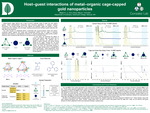
Metal–organic cages (MOCs) are a class of porous materials made of metal ions and organic ligands. These self-assembled compounds have promising applications in catalysis, sensing, biomedicine, and energy storage due to their stability and tunability. Cages vary greatly in shape, internal cavity size, solubility, and net charge, enabling supramolecular binding to guest molecules with high affinity and selectivity.
Our work focuses on tetrahedral MOCs constructed with zirconium-based nodes and phenyl-containing organic ligands. We modify gold nanoparticles (GNPs) with our cages to maximize selectivity and reactivity in hydrogenation reactions for industrial applications; cage porosity enables selectivity while maintaining high reactivity by providing access to the gold surface.
In this study, we examined the effects of solvent and relative cage and guest size on host–guest behavior. Our objective was to identify a guest molecule with strong binding affinity for our cages. Through this, we could confirm the tetrahedral geometry of our MOCs. Further, we could use host–guest binding to block the cage internal cavity in hydrogenation control experiments. These experiments would prove that reactants must go through the pore during catalysis.
Publication Date
Spring 5-2025
Keywords
host–guest chemistry, metal–organic cages, supramolecular chemistry, NMR
Disciplines
Chemistry | Materials Chemistry | Other Chemistry
Dartmouth Digital Commons Citation
Lu, Megan K.; Deng, Zhou; and Gonzalez, Miguel I., "Host–Guest Interactions of Metal–Organic Cage-Capped Gold Nanoparticles" (2025). Wetterhahn Science Symposium Posters 2025. 14.
https://digitalcommons.dartmouth.edu/wetterhahn_2025/14
Restricted
Available to Dartmouth community via local IP address.
