

Files
Download Full Text (10.3 MB)
Student Class
2028
Student Affiliation
WISP Intern
First Advisor
Kristina Lynch
First Advisor Department
Department of Physics and Astronomy
Second Advisor
Rowan Kowalsky
Second Advisor Department
Department of Physics and Astronomy
Description
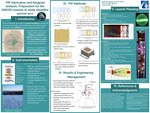
The upcoming Geophysical Non-Equilibrium Ionospheric System Science Rocket (GNEISS) mission aims to investigate the structure and dynamics of the auroral ionosphere by deploying a fully instrumented multipoint, multiplatform payload suite into the Alaskan ionosphere in March 2026. This project supports GNEISS through the fabrication of Petite Ion Probes (PIPs) and analysis of auroral keograms derived from all-sky imagery. PIPs are used to measure ion flux and are mounted on both main and subpayloads to provide spatial insight into electron precipitation patterns. We detail the step-by-step assembly process for PIP stacks using gold-coated mesh and screens and report improvements in fabrication methods that reduced mechanical wrinkling. Additionally, keogram analysis was performed on March 2025 auroral data to develop magnetic field-aligned expectations for GNEISS, correlating observed structures with reconnection signatures. These efforts inform both instrument readiness and scientific planning.
Publication Date
5-2025
Keywords
aurora, ionosphere, GNEISS mission, PIP, keogram
Disciplines
Plasma and Beam Physics
Dartmouth Digital Commons Citation
Pflaum, Annie and Martinez, Dayanara, "PIP fabrication and Keogram analysis: Preparation for the GNEISS mission to study sheetlike auroral arcs" (2025). Wetterhahn Science Symposium Posters 2025. 4.
https://digitalcommons.dartmouth.edu/wetterhahn_2025/4
Restricted
Available to Dartmouth community via local IP address.
