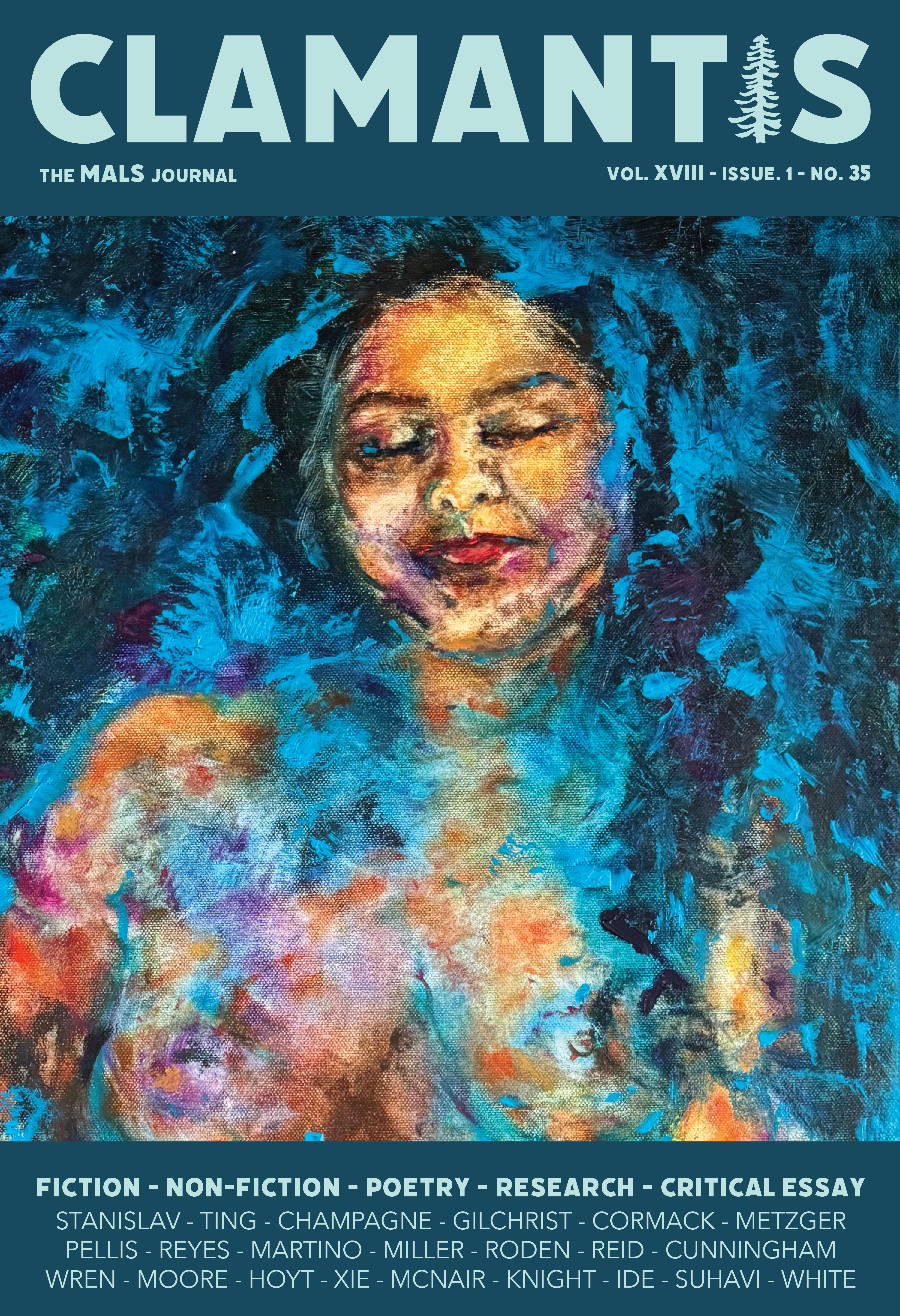
Welcome to the home of Clamantis: The MALS Journal!
For general information and questions about getting involved as an editor, please go here.
The most recent issue of the journal can be found below.
Current Issue:
Letter from the Editor & Note from the Editors: On Volume Numbering and A Celebration of 20 Years in Print
Joining Clamantis was the first thing I did at Dartmouth. It was August of 2023, I had moved up weeks ahead of orientation to secure housing and a job, and I was on my computer after work when a “Call for Editors” popped up in my inbox. Having immediately replied, I found myself shortly after sitting around the Guarini Commons conference table, trying to sneak bites of pizza while maintaining my dignity, the meeting having already started. I knew no one; it was my first time in the building. I was anxious, but I’d come here to see if I could be a writer, and I knew this group would help me along the way.
Twenty years ago, MALS students published the first edition of the MALS Quarterly. Over the years, and with the input of hundreds of dedicated students, our journal has evolved into the edition you have before you. Each leap forward has been propelled by the desire to provide the highest quality, most professional venue for our students’ work. The diligent work of previous boards has standardized our processes, policies, and procedures, streamlining the publication process and allowing all of our editorial staff to focus more on the editorial decisions that most impact our submitters. The past two boards have worked to create a recognizable Clamantis image and brand, as well as reactivating our ISSN, to ensure ease of categorization for the archiving of our print edition.
With this, and more, in mind, our theme for this edition is “New Frontiers.” We wanted to celebrate the boundary-pushing work of our authors, as well as the hunger that drives the creative process, animating the characters and curiosities our work brings to life. I have read so many outstanding works in my four issues with Clamantis and met so many wonderfully creative, curious, and talented members of our community. Ed Ting, Ilyse Horlings, and Caden P. Ide bring us art and poetry from the final frontier, while “Naked Stem” and “Meditation on Winter's Bare Trees” challenge our attention to the overlooked beauty of our own backyards. “Dear Mother” experiments with form to bring alive the extremes of unconditional love, while our research pieces explore the cultural and intellectual vanguards of Urdu rap and Mormon feminism.
I’m proud of this, my final issue with Clamantis . While there are too many people to thank by name, I’d like to share my sincerest appreciation for Jasmine Shirey, who welcomed and supported me as a new editor, Vibha Vasanth, who welcomed me to the board and showed me the ropes, and Mack Bennett, with whom I took my first six MALS courses and who has always believed in and pushed me towards my best in classroom and boardroom alike. Many thanks to all the board members and editors I’ve served alongside, all the authors who have entrusted me with their work, and to our lodestar, Professor Anna Minardi.
Welcome to Clamantis: Volume XVII Issue 1 . I hope you enjoy it as much as I have.
— Jacob Campbell, Editor in Chief
Note from the Editors: On Volume Numbering & A Celebration of 20 Years in Print
As we sat down to work on this issue, we had yet to learn one important fact: Clamantis turns 20 this year. We’d venture to guess that we’re not the only folks in the Dartmouth community for whom this comes as a surprise. We also think this discovery says something special about the quiet resilience of this journal.
Across twenty years, the Dartmouth MALS program has been printing student and alumni work across a wide range of disciplines. It has published rigorous, complex research in the fields of cultural studies, globalization studies, liberal studies and the medical humanities. The journal has also welcomed work from our fellow graduate student peers in the Guarini School, who are engaged in groundbreaking research in computer science, cognitive neuroscience, molecular and cellular biology, and health policy, among other fields. In terms of creative work, Clamantis has featured a rich range of poetry, short stories, dramatic writing, personal essays, art, photography, and hybrid work that defies easy categorization. All of this—both research and creative work—is the kind of work that perfectly captures the spirit of our interdisciplinary graduate program.
The journal has—as is to be expected—taken many forms over the last two decades. It first emerged as The MALS Quarterly, then shortly after transitioned into what simply known as, The Journal. In 2017, the MALS community gathered to shape a more lasting identity and settled on Clamantis, a nod to Dartmouth’s motto. Clamantis, in Latin, translates to “crying out,” which we believe speaks profoundly to the mission behind our journal: to give voice to new ideas, and emerging writers and scholars.
Over this span, the journal has grown, evolved, and adapted. In some years it has printed four editions, some years only one. When COVID-19 hit, it shifted entirely to digital publication, like many small journals trying to survive.
This issue of Clamantis marks an important shift in how we identify and catalog our publication. Beginning with this edition, we are adopting a numbering system that reflects the full history of the journal’s print publication, dating back to its origins in the mid-2000s. While the journal has historically followed a numbering system without a formal basis in publication history, we believe this adjustment better honors the journal’s true continuity and the contributions of all those who have come before us. Henceforth, “volume” will refer to the number of years the journal has been in print. Clamantis is a biannual publication, as we publish two issues per year: Issue One in the spring, and Issue Two in the fall. This approach follows widely accepted cataloging conventions for academic journals, such as those recognized by the Library of Congress and other indexing institutions.
It is also important to note that, although the MALS program has been publishing student work for twenty years, Clamantis did not take on the form of what we would consider a true journal until 2008. For this reason, we are designating this year’s issues as a part of Volume Seventeen (XVII) and will be forging ahead from that number. The proper total number of journal issues published to date is thirty-three accounting for years with only one issue, as well as periods when the print journal briefly went offline. Thirty three editions of student work is a legacy worth celebrating, and we invite you to celebrate with us by reading the vivid, bold work included in this edition.
We recognize that this change may appear abrupt, but also acknowledge that past inconsistencies in formatting were the result of natural turnover in a student-led publication. As Clamantis continues to grow and seek broader exposure for the work of its contributors, maintaining an accurate and transparent publication record becomes increasingly important—both for readers and for the platforms and archives that may one day house our work.
This decision was made unanimously by the Editorial Board, in consultation with our faculty advisor, and with a shared goal: to elevate the journal’s standing, preserve its legacy, and ensure clarity and consistency for future editors and contributors alike. We also hope that this ensures that the next milestone Clamantis reaches should not come as any surprise to anyone in the greater Dartmouth community.
We look forward to what lies ahead.
— The Editorial Board
Poetry
Stargazing Tonight
Ilyse Horlings
Mexican American
Isdaly Reyes
Touchstone
Thea Calitri-Martin
Run-On-Mouth
Thea Calitri-Martin
The Softness of Belonging
Richel Cuyler
Fiction
Young Boy and the Wallet
Isdaly Reyes
Dear Mother
Mackintosh Bennett
Non-Fiction
The Pillar
Jacob Campbell
Meditation on Winter's Bare Trees
Reng Zhao
Artwork
The Celestial Progenitors
Caden P. Ide
Naked Stem
Abigail Dollries
The Great Orion Nebula
Ed Ting
Research
Editors
- Editor-in-Chief
- Jacob Campbell
- Editorial Board Members
- Mackintosh Bennett
- Abigail Dollries
- Caden P. Ide
- Andrew Moore
- Chelsee Niebergall
- Faculty Advisor
- Anna Minardi
- Editors
- Giselle Hart
- Joel Papp
- Cosima Pellis
- Assistant Editors
- Crista Fiala
- Matthew Fennelly
- Elysee Sadia
- Andrée Solé
- Amanda Watson
- Keehan White
- Mindy Wren
- Alumni Editors
- Alhanouf Almaghrabi (Asst.)
- Rachel Bates (Asst.)
- Maria Iriondo (Asst.)
- Lilabeth Martchenke (Asst.)
- Behishta Sadaat (Asst.)
- Ed Ting (Asst.)
- Cover Art
- Jennifer Campbell Cormack