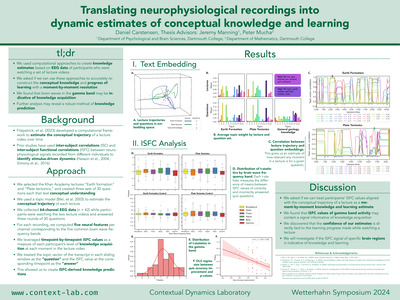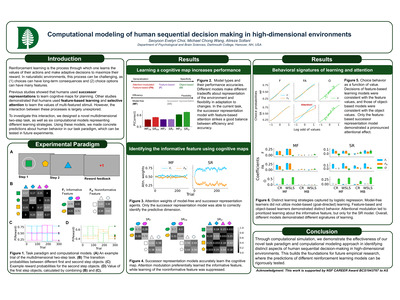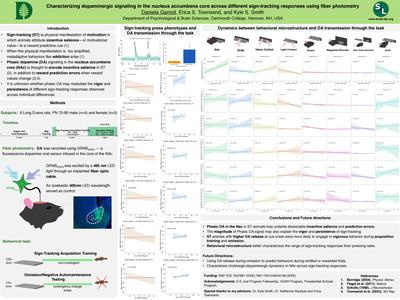

The Wetterhahn Science Symposium celebrates Dartmouth undergraduate science research.
-

Carbon Storage in Headwaters Can Respond Rapidly to Climate Change
2026
Maddie Benello, Carl Renshaw, and Joshua Landis
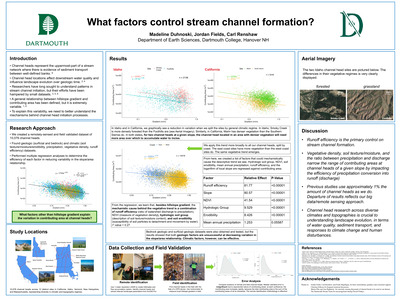
Headwater streams play a critical role in the global carbon cycle, serving as significant sites of carbon storage. While there have been recent efforts to quantify carbon storage in headwater streams in the western United States, there remains limited understanding of both the volume and timescale of carbon storage in northeastern forests which often have extensive logging and agricultural histories. Here, we quantify the carbon stock, residence time, and flux of a zero-to-first order headwater stream in Charles Downer State Forest (DF), VT using novel fallout radionuclide (FRN) chronometry. We find DF headwaters have a carbon stock of 66.2 Mg ha-1 stored on average for 10.6 years. The corresponding flux of 613 g m-2 y-1 is many times higher than other fluvial margins and temperate forests, driven by funnelling of organic matter and high permeability floodplain soils. Northeastern residence times are inconsistent with the model of sediment transport controlled carbon storage proposed for the Pacific Northwest, suggesting carbon dynamics in Northeast systems differ and are driven by a combination of high subsurface flux, microbial respiration, and hyporheic flow. The decadal residence time of carbon in the northeast indicates that these headwaters are sensitive on timescales of climate change and that strategic management of these systems, such as through the reintroduction of logjams, could significantly increase their carbon storage potential on timeframes relevant to the green energy transition.
-

The Cannabis Motivation Spectrum: Comparing Medical, Recreational and Dual Intent Users
2026
Addyson Domian and Jacob Borodovsky
There is a lack of a standardized definition of “medical” cannabis use in the healthcare industry, which has led to an informal, user-reported definition of medical use. Consequently, individuals who use cannabis for both medical and recreational reasons (dual intent) are not always differentiated from pure medical or pure recreational users. This study compares self-defined medical only and dual intent motivational groups relative to recreational only users to better understand how these groups differ by analyzing sociodemographic and use patterns, clinically relevant factors, and claimed cannabis-related benefits. Using data from the Qualtrics Cannabis Exposure Index survey instrument of 8836 adult cannabis users, logistic regressions were performed to calculate adjusted odds ratios across these dimensions. Distinct profiles were identified among the three motivation groups. It was found that dual intent users exhibited higher use intensity, had a greater likelihood of experiencing cannabis use disorder criteria, and claimed a broader range of benefits of cannabis. In comparison, medical only users demonstrated more doctor engagement and followed a similar pattern of claimed physical benefits to dual intent users. Recreational only users demonstrated the lowest doctor engagement and emphasized social benefits. These findings are important for continuing to understand the evolving definition of medical cannabis use. The results may be helpful in informing clinical practices, public health needs, and policies surrounding cannabis legislation in the United States.
-

Electropulse Annealing: Phase Composition of TiAl6v4
2026
Vaughn Eckhardt, Ethan Croke, Ian Baker, and Russ Taylor
Titanium alloy TiAl6V4 is the most ubiquitous titanium alloy used for dental care, aerospace manufacturing, and for high performance vehicles. The material typically undergoes a thermal heat treatment, but electropulse annealing is another process that involves sending current through the material to heat it up at a quicker rate. The rate of post-annealing cooling is high, and around the material's critical point, its two components, alpha and beta phase, change in relative concentration. After testing multiple current densities and temperatures, in general, as the current density that the sample received during electropulse annealing decreased, both the alpha and beta phases stabilized, increasing microhardness. Therefore, by stabilizing the composition of both phases, the alloy was strengthened.
-

Pixel-Level Fiber Stratification: Quantitative Imaging Analysis of Pigmented Lesion Morphology
2026
Alexia R. Gerogiannis and Caroline R. Saint James
Using a combined two-photon excitation fluorescence (TPEF) and second-harmonic generation (SHG) approach, our research seeks to further the quantification of skin components in a quest toward diagnostic tools with higher accuracy and reduced invasiveness for patients. Images are taken both ex vivo and in vivo, of healthy and malignant tissues, with a 600 × 600 micron field of view. We demonstrate how computational analysis can effectively exploit signals emitted by skin to provide diagnostic insight.
-

Density and fiber alignment of the fibrous extracellular matrix in ovarian cancer metastases
2026
Rachel Glantzberg, Aditi Singh, and Mohammad Asghar Qanit
The primary aim of this project is to improve and justify biophotonic approaches to label-free, non-invasive cancer detection, particularly within the context of peritoneal metastases from ovarian cancer. Ovarian cancer often metastasizes to the peritoneum, resulting in microanatomical changes in collagen and elastin fiber direction and density. While prior research has provided insights regarding collagen density changes in other types of cancer, peritoneal metastases from ovarian cancer remain minimally characterized, particularly in regards to elastin fibers. Preliminary results suggest that there is a difference in the elastin and collagen contents of healthy and cancerous tissues and that these contents differ in fresh, fixed, and stained human tissues. By obtaining images and conducting analysis on 2PF and SHG signals, which exploit the intrinsic autofluorescence of elastin fibres and the second harmonic generation of collagen respectively, the unique properties of collagen and elastin architecture within peritoneal metastases can be established, justifying the functionality and practicality of endoscopic cancer detection.
-

Probing FeNi Alloys with Atomic Precision
2026
Scipio Han, Kaushik Rajkumar Jayaprabha, and Xin Qi
We compared EAM and MEAM atomic potentials for modeling FeNi (tetrataenite), a rare 50/50 alloy found in meteorites. Picking 4 potentials, we calculated minimum lattice constants and order-disorder transition temperatures. MEAM potentials accurately predicted the experimental transition temperature, confirming that MEAM better captures FeNi's directional bonding.
-

High-Throughput Robotic Ethanol Inhibition Assays for Engineered Thermophilic Biofuel Strains
2026
Kevin He, Daniel Olson, Marybeth Maloney, and Anthony Lanahan
Ethanol stress assays are commonly used to evaluate microbial tolerance, metabolic adaptation, and fermentation performance. However, manual liquid handling introduces variability across replicate wells and small-volume pipetting steps, limiting reproducibility and throughput. This study developed an automated OT-2 robotic workflow to generate replicated ethanol concentration gradients for high-throughput inhibition assays in engineered thermophilic biofuel strains. Kinetic plate-reader measurements were used to quantify ethanol-dependent growth responses under anaerobic fermentation conditions. The reasearch question is: How do engineered thermophilic biofuel strains differ in ethanol-dependent growth inhibition under anaerobic fermentation conditions, and can automated robotic assays improve the reproducibility of these measurements? Can high-throughput robotic ethanol inhibition assays reliably generate reproducible ethanol gradients and reveal strain-specific tolerance responses in engineered thermophilic biofuel organisms?
-

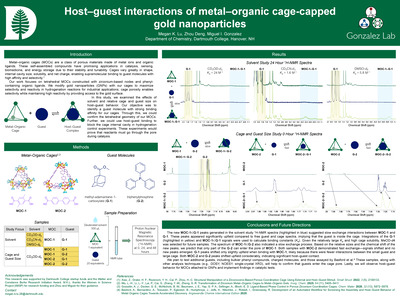
Zirconium Metal-Organic Cages: Synthetic Development of Chromium-Functionalized Ligands
2026
Jim P. Heller, Jonathan E. Pines, and Miguel I. Gonzalez
Metal-organic cages (MOCs) are a class of highly porous molecules composed of inorganic clusters bridged by highly tunable organic ligands. The synthesis and development of various ligands could allow for more selective and efficient catalysts. Specifically, Chromium-based homogeneous catalysts have recently been commercialized due to their high selectivity in the production of 1-hexene and 1-octene. This project aims to synthesize reusable heterogeneous catalysts composed of chromium-functionalized zirconium MOCs deposited on mesoporous supports.
The current focus of this project is to synthesize and purify the "SNS Ligand." This ligand can coordinate to chromium via its S—N—S moiety. This project specifically focuses on the synthesis of this complex terphenyl ligand component which requires careful chemical transformations. Because the S—N—S moiety is chemically similar to mustard gas, this work should be approached with caution.
-

Effects of In Utero Alcohol Exposure on Migration of Postmitotic Projection Neurons in Somatosensory Cortex and Medial Prefrontal Cortex in Postnatal Day 0 Mice
2026
Erika Huston, Hermes H. Yeh, and Pamela W.L. Yeh
Delatour et al. concluded that TBR1-expressing cell bands were diffused due to pre-natal ethanol exposure in embryonic day 16.5 mice. I hypothesized that this effect would also be observed in post-natal day 0 mice. Calculating the length of the lower cortical plate compared to the entire cortical plate, comparing the fluorescence intensity of the upper and lower cortical plate, and mapping the progression of fluorescence intensity through the cortex were methods used to evaluate this hypothesis. With consideration for the limited sample size, significant results were not obtained. However, effect sizes for the overall and progressive somatosensory cortex fluorescence intensity comparison as well as the overall medial prefrontal cortex fluorescence intensity comparison were found to be large. This indicates that future studies with more litters may find significant results.
-

Measuring the Impact of 3D Printers on the Health of Youth
2026
Alexis Kostin, Olla Obeid, and Oz Trost
3D printers are used more widely than ever before; they can be found in factories, hospitals, and even schools. However, the health effects of the VOCs and UFPs that these machines emit have yet to be fully understood. In collaboration with the University of Nevada, Las Vegas, this study utilizes an Air Gradient One sensor at the Diamond Lab to monitor VOC and UFP emissions before, during, and after 3D printing sessions. By comparing these levels to EPA and CDC safety standards, we aim to quantify the respiratory risks posed to youth.
-
Training a Cellpose Model for T-Cell Cytoplasm and Nucleus Segmentation
2026
William Laws, Matthew Lindley, and Irene Georgakoudi
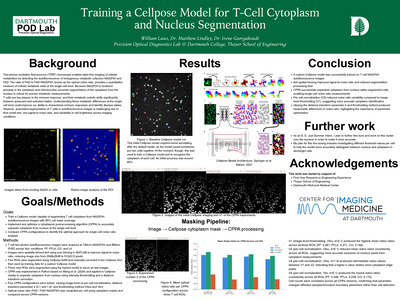
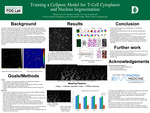
Accurate single-cell segmentation of cytoplasm from nucleus in autofluorescence images is critical for quantifying cellular metabolism using the optical redox ratio (FAD / FAD+NAD(P)H). However, automated cytoplasmic segmentation of T cell two-photon excitation fluorescence images remains challenging due to low signal-to-noise ratio, small cell size, and variability in cell brightness across imaging conditions. Here, we present a pipeline combining a custom-trained Cellpose-SAM model with an adapted cytoplasmic post-processing algorithm (CPPA) for automated single-cell metabolic analysis of T cell NAD(P)H autofluorescence images. Raw 2048×2048 pixel images were spatially binned 4×4 in MATLAB to improve signal-to-noise ratio and reduce processing time. A custom Cellpose-SAM model was trained on five manually corrected T cell regions of interest spanning multiple experimental conditions and validated on three unseen images, detecting between 110 and 262 cells per image. CPPA was implemented in Python and applied to Cellpose masks to separate cytoplasm from nucleus using per-cell intensity normalization, percentile-based thresholding, distance transform edge correction, and connected component nucleus cleanup. Six CPPA configurations were evaluated by comparing per-cell redox ratios across three test images. Per-cell normalization outperformed image-level thresholding, and a 60th percentile threshold with dim-cell correction produced the most visually accurate cytoplasm and nucleus masks. This pipeline enables automated, single-cell metabolic analysis of T cell autofluorescence images and provides a foundation for characterizing metabolic heterogeneity across immune cell populations.
-

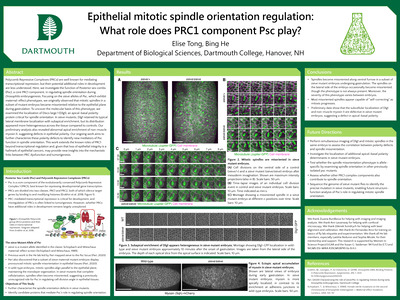
The Effects of Solutes on the Growth of Crystals in Polycrystalline Ice
2026
Roberto Nieto Jr, Chinazom Onubogu, and Ian Baker
The structure of sea ice (NaCl-doped water) differs from freshwater ice. In this project, we will be investigating how ice grows when doped with various solutes such as sodium chloride and sulfuric acid. There are two projects that were investigated. The first project consisted of finding the velocity of the ice growth of deionized water, saltwater, and water doped with sulfuric acid. The second project consisted of observing how the polycrystalline structure of ice differs between deionized water, saltwater, and water doped with sulfuric acid.
-

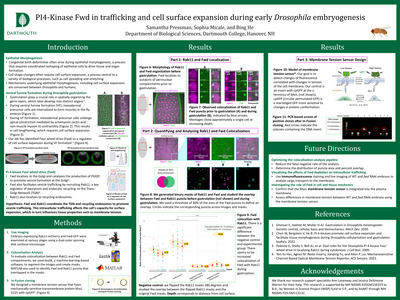
Cell surface expansion and tension regulation: how cellular forces shape embryonic development
2026
Samantha A. Pressman, Sophia M. Micale, and Bing He
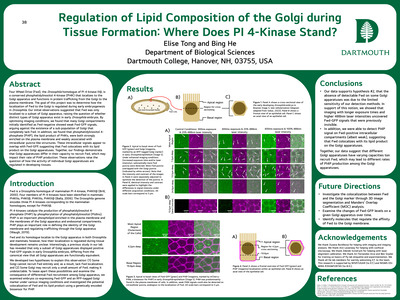
Congenital birth deformities often arise during epithelial morphogenesis, displaying the need to understand the mechanisms underlying this process. Cell shape changes that mediate morphogenesis often require cell surface expansion to accommodate shifts in 3D tissue geometry. Our lab has identified Four Wheel Drive (Fwd), a Golgi-localized phosphatidylinositol 4-kinase (PI4K) IIIβ ortholog, as a regulator for cell surface expansion during Drosophila ventral furrow formation, a well-characterized model for epithelial folding. We hypothesize that Fwd and Rab11, a regulator of exocytosis and endocytic recycling, coordinate the trans-Golgi network and recycling endosomes to promote vesicle trafficking. Using live imaging of fluorescently tagged Fwd and Rab11, we find that Fwd shows spatial proximity to Rab11-positive compartments during gastrulation. Furthermore, Fwd-deficient embryos display a more uniform hexagonal organization and reduced membrane dynamics prior to gastrulation. During gastrulation, Fwd-deficient embryos exhibit elongated cell morphology, which may reflect alterations in the global pattern of tissue flow or in tissue fluidity, and increased cell displacement, which may reflect stronger mechanical coupling between neighboring cells due to increased cell rigidity. To directly measure how Fwd influences membrane tension, we are developing a genetically encoded membrane tension sensor. Together, these findings and experiments will provide insight into how intracellular trafficking coordinates cell surface expansion and tissue mechanical properties during epithelial morphogenesis.
-

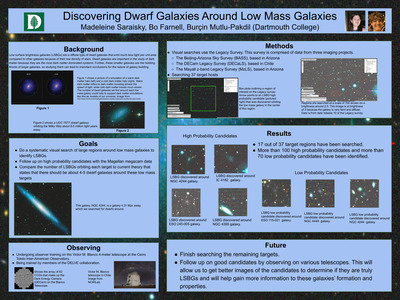
Distance Calculations of Faint Dwarf Galaxies Through Surface Brightness Fluctuations
2026
Blake A. Richesin, Guinevere Herron, and Burçin Mutlu-Pakdil
This study aims to test the effectiveness of the surface brightness fluctuations (SBF) technique in determining the distance to three distinct galaxy targets. The targets were dwarf galaxies Tucana B, Kamino, and Hedgehog. The technique used image masking, Sérsic profiles, and convolving with point spread functions (PSF). The study showed that redder, quenched galaxies are prime candidates for the SBF technique, while bluer, star-forming galaxies are more difficult to constrain the distance of.
-

”Wet floodplains” Protect Carbon Sequestration Hot Spots: How Carbon Sequestration Varies Across The Floodplain
2026
Jacob Schnell, Joshua Landis, Jordan Fields, and Carl Renshaw
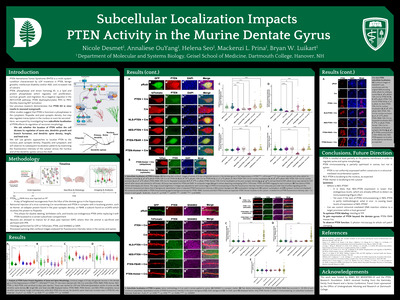
Carbon hot spots (peats) store 2̃0x more carbon, and at a faster rate than any other area on the Dead Diamond floodplain. The fluxes found in this study give us a reference template for how river restoration could proceed, including how current techniques might be actively mismanaging these hot spots.
-

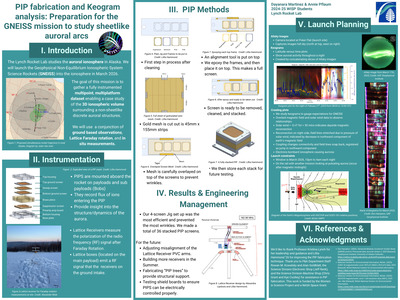
Preliminary observations from the Relativistic Electron Atmospheric Loss (REAL) satellite mission
2026
Evzen Selvon and Robyn Millan
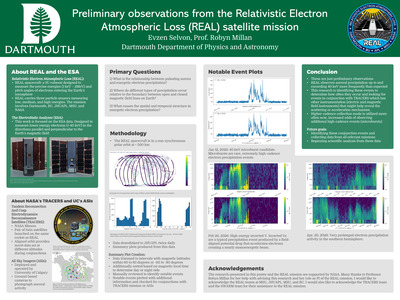
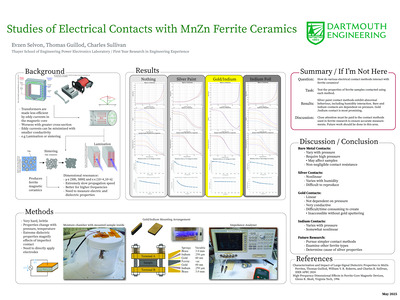
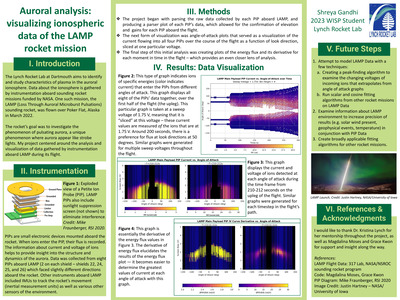
The Relativistic Electron Atmospheric Loss (REAL) spacecraft (launched in July 2025) is a 3U cubesat designed to measure the precise energies (1 keV – 2MeV) and pitch angles of electrons entering the Earth’s ionosphere. The mission involves Dartmouth, BU, JHUAPL, MSU, and NASA. REAL carries three particle sensors measuring low, medium, and high energies. This work is focused on the ElectroStatic Analyzer (ESA) instrument, designed to measure lower energy electrons (1-40 keV) in the directions parallel and perpendicular to the Earth’s magnetic field. This research aims to identify notable events observed by the REAL spacecraft for future analysis.
-

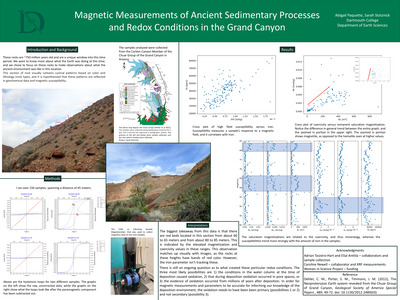
Exploring Mesoproterozoic Marine Redox States in a Young Banded Iron Formation from the Needle Mountains
2026
Jaya Sharma and Brenhin Keller
Banded iron formations (BIF), as redox-dependent chemical sedimentary rocks, have served as proxies for marine and atmospheric oxygen and iron conditions throughout Earth history. While abundant in the Archean and early Proterozoic, the widespread deposition of BIFs declined following the Great Oxidation Event, as oxygenated surface waters prevented the accumulation of ferrous iron. However, the Needle Mountains, located in southwestern Colorado, houses an anomalously young BIFs deposited between 1.786±10 - 1.801±6 Ga given existing geochronology. Here, we use rare earth element (REE) systematics, bulk chemistry, and petrographic analysis to determine the depositional conditions under which this BIF was formed. We hypothesize that this BIF was deposited in a restricted or partially restricted stratified basin, with mafic hydrothermal Fe input and felsic continental REE input. Bulk geochemical analysis and laser ablation inductively coupled plasma mass spectrometry (LA-ICP-MS) were used to determine elemental compositions in magnetically separated mineral fractions of primarily chert and magnetite. We determine that, when chondrite-normalized, there is a distinct negative Eu/Eu* anomaly (0.67-0.84), a neutral to positive Ce/Ce* anomaly (1.12) of the magnetic fraction, a strong LREE/HREE enrichment, and suprachondritic Y/Ho values. These observations support our hypothesis and are interpreted within the tectonic context of the back-arc basin that developed between the assembling of the Yavapai and Mazatzal Provinces during the formation of the supercontinent Columbia, providing a restricted marine setting for the formation of the Needle Mountain BIF. These findings ultimately support the view that ferruginous anoxic basins suitable to the precipitation of BIF continued to persist locally into at least the Statherian
-
Histopathology and applications of event-based cameras
2026
Jace Sung, Kelly Lao, Quinton Qu, and Adithya Pediredla
Capturing and analyzing visual phenomena at their natural time scale is critical in both science and engineering. For instance, in industrial manufacturing, high-speed capture of defects and crack propagation ensures quality control. In sports, capturing high-impact collisions in football or rugby helps in better understanding injury mechanisms and developing more effective prevention strategies. In autonomous robotics, drones, and cars, high-speed cameras enable split-second decisions, even during fast maneuvers. However, high-speed cameras are expensive, costing upwards of $100,000, and are bulky, limiting their widespread adoption. Recently, event cameras have emerged as an affordable, small-form-factor alternative, but they only capture binary temporal differences of the scene in the form of events. Reconstructing the high-speed scene from events is non-trivial and ill-posed. The focus of the research will be on co-designing hardware and reconstruction algorithms enabling the capture of rich information about the scene, a field known as computational imaging/photography. This may include designing and building optical hardware prototypes to capture additional information about the scene, developing ,and coding the reconstruction algorithms, or exploring various applications of high-speed imaging.
-

Risky Decision-Making Under Uncertainty
2026
Suyoung Yoo and Jae Hyung Woo
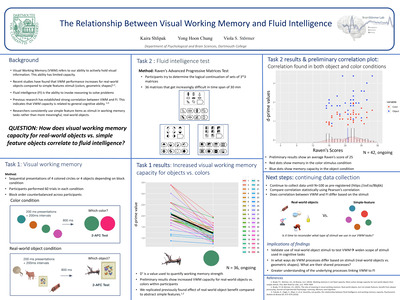
This research project aims to discover how a person’s brain continuously learns about its changing environment and how those memories dynamically alter their subsequent willingness to take risks. By testing 73 participants on a two-stage computer module, the study evaluates whether humans evaluate risk absolutely or relatively to their historical surroundings. In Stage 1, participants use reinforcement learning to track a hidden, shifting "lucky room" context. In contrast, in Stage 2, they face explicit two-option gamble cards in which they must weigh different point amounts and win percentages. Computational maximum likelihood estimation proved that a Subjective Utility (SU) model, which captures how the human brain subjectively shrinks the emotional value of giant numbers while non-linearly warping percentages, significantly outperforms basic, robot-like Expected Value (EV) models. Ultimately, by locking these stages together in an integrated framework, the project tests the hypothesis that the environmental values learned in Stage 1 act as a moving internal baseline or dynamic reference point that continuously reframes downstream risk calculations, offering mathematical insights into why decision-making can become rigid in psychiatric conditions like anxiety, OCD, and addiction.
-
Dynamics of Localized Wave Packets in Quantum Mechanics
2026
Ayla Zook, Keigo L. Fujita, and Rufus Boyack PhD
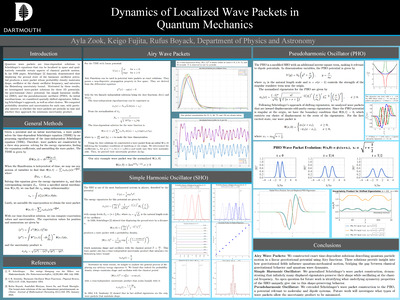
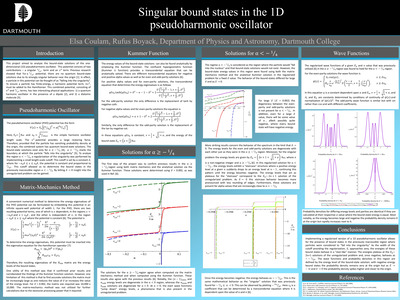
Quantum wave packets are localized, time-dependent solutions of the Schrödinger equation that mimic classical particle motion. In his 1926 paper, Schrödinger famously showed that displacing the ground state of the harmonic oscillator produces a wave packet whose probability density maintains its shape and saturates the Heisenberg uncertainty bound. Motivated by this result, we construct and analyze wave-packet solutions for the Airy potential, the simple harmonic oscillator (SHO), and the pseudoharmonic oscillator (PHO). Our general approach is to find expansion coefficients and take a superposition of the energy eigenstates of the time-independent Schrödinger equation. We examine spatially displaced eigenstates alongside alternative constructions, computing probability densities and uncertainty products to determine whether each wave packet maintains shape, is periodic in time, and whether it approaches the minimum uncertainty limit. For the Airy potential, we build exact, non-dispersive solutions from Airy functions, illustrating how a gravitational field shapes quantum motion. For the SHO, we generalize Schrödinger's original construction, showing that infinitely many displaced eigenstates preserve their shape while oscillating at the classical frequency. For the PHO, we extend this construction to a potential with a singular repulsive core. These results clarify when localized wave packets behave classically and remain coherent. Open questions include identifying the symmetry underlying the SHO's shape-preserving behavior and determining which PHO wave packets minimize the uncertainty product.
-
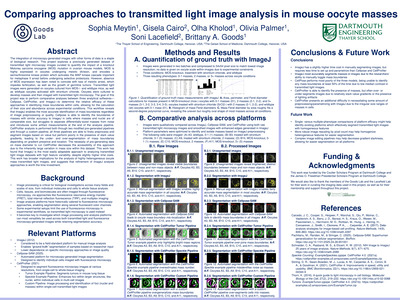
Precision Without Invasion: The Path to Biopsy-Free Cervical Diagnostics
2025
Samuel Adjei, Anya Ramrakhiani, Aditi Singh, Petros Taxiarchis, and Rachel Glantzberg
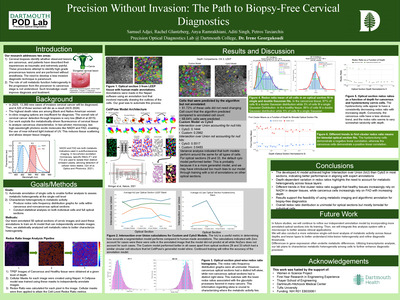
This study explores a non-invasive, biopsy-free method for diagnosing cervical cancer using two-photon excitation fluorescence imaging and AI-driven image analysis. Researchers trained a custom Cellpose model to automatically annotate single-cell metabolic data from optical sections of cervical tissue based on redox ratios derived from NADH and FAD autofluorescence. Results showed that the custom model outperformed generalist alternatives in identifying cellular structures and that cancerous and healthy tissues exhibit distinct redox ratio distributions and depth-dependent metabolic trends. These findings underscore the potential of metabolic imaging and automated analysis to reveal intra-lesion heterogeneity and improve diagnostic precision.
-
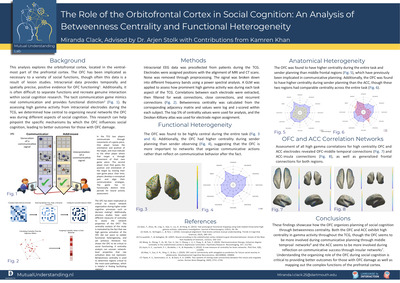
The Role of the Orbitofrontal Cortex in Social Cognition: An Analysis of Betweenness Centrality and Functional Heterogeneity
2025
Miranda Clack, Arjen Stolk, and Kamren Khan
Research into the role of the orbitofrontal cortex in social cognition has been dominated by lesion studies. While the OFC has been suggested to organize large neural networks and contribute to appropriate social behavior, this bias towards lesion studies fails to provide positive evidence of the specific function the OFC facilitates. This study utilizes iEEG high gamma data for an analysis of betweenness centrality in the OFC during a social task to bridge the gap in knowledge. The OFC is found to exhibit high centrality across the entirety of a social task as well as during the planning of communicative behavior in comparison to frontal control regions. Further exploration into the networks that the OFC organizes implicates a high frequency circuit connecting the OFC, middle temporal, and other frontal regions. These results provide insight into the network-level dynamics of the OFC and can be helpful in understanding the clinical implications of OFC loss of function.
-

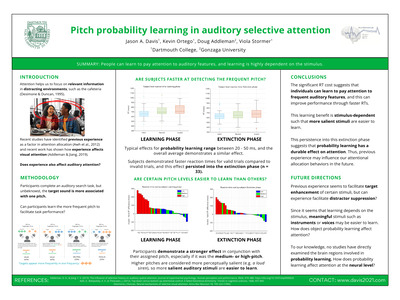
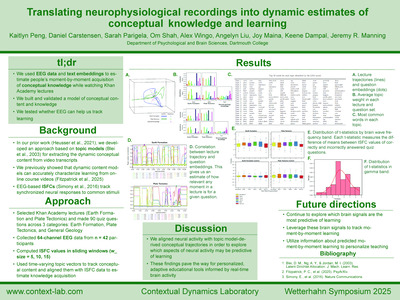
Pitch probability learning in auditory selective attention
2025
Jason A. Davis, Kevin Ortego, Doug Addleman, and Viola Stormer
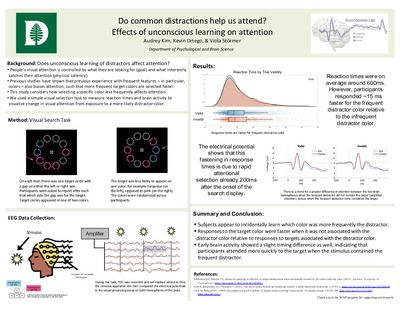
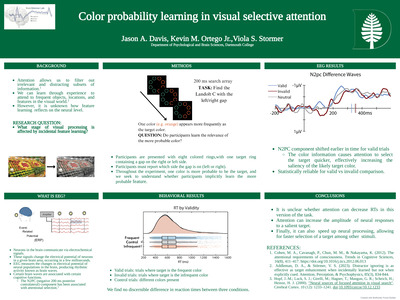
Extensive evidence suggests that previous experience guides visuospatial attention. For instance, studies of location probability learning demonstrate that repeatedly finding a search target in a particular region of the visual field produces attentional biases for that region (Jiang et al., 2013; Addleman, 2019). Similarly, Addleman (2019) demonstrated a comparable auditory effect whereby repeated location of an auditory target induced attentional preference for the specific region. However, there have been fewer explorations of whether the repeated selection of auditory non-spatial features, such as pitch, influences auditory selective attention. Can participants incidentally learn the probability structure of simple auditory features such as pitch, and use this experience to more effectively select more probable target sounds?
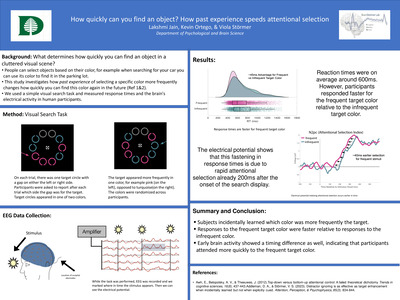
To investigate this question, we developed an auditory search paradigm where participants heard two sounds presented to both ears simultaneously and were tasked to report the location (left vs. right) of a target sound, which contains a brief gap. Unbeknownst to the participants, targets were disproportionately more likely to appear in one pitch (either low, medium, or high, counterbalanced across participants) than the other two. In a subsequent extinction phase, targets were equally likely to occur in all three pitches. We tested whether participants would be faster for frequent versus infrequent target sounds across both experimental phases. Our results showed that participants were faster at detecting that target sound that was associated with the frequent pitch, and this learning persisted, at least to some extent, into the extinction phase. However, we also observed that the magnitude of this probability learning was stimulus-dependent, such that higher pitched sounds exhibited the strongest learning benefit. This work suggests a critical role for stimulus salience in long-term probability learning, as stimulus salience may modulate the strength of probability learning, at least in auditory selective attention. Broadly, this study generalizes effects of probability learning in the visual domain to feature-based attention in the auditory domain, providing a first stepping stone to understanding how experience shapes selective attention across sensory domains.
-

Predicting Ad Hoc Categories with Word Embeddings
2025
Alina Dracheva, Yiran Jiang, and Alexandra Anderson
The goal of the project is to develop a system which predicts what comes to mind for novel ad hoc categories using large language models. Ad hoc categories, formed in response to situational demands, reflect the flexibility of human thinking. Building on prior research into how word embeddings are situated in human feature spaces and representational techniques of language models, this project aims to investigate if language models can emulate the human process of creating ad hoc categories. Ad hoc category formation operates in a multidimensional feature space, where items with similar scores are clustered along contextually relevant dimensions. As such, word embeddings may model human conceptual representations, which our experiment aims to test. To test this, participants will interact with a web platform to generate members from novel prompts that combine base words and modifiers, for example, “A zoo animal you can bring on the plane”. Responses will be situated in a human-derived feature space and compared to word embeddings created using fastText. Dissimilarity matrices derived from the embedding space and the human derived feature space will be used to compare the structure of relationships between items in each space. This approach will reveal the dimensions most predictive of an ad hoc category and could be generalized to other bases. Findings would have broad implications on the representational potentials of large language models and their alignment with human conceptual organization.
-
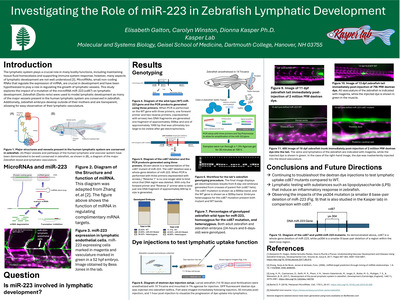
Investigating the Role of miR-223 in Zebrafish Lymphatic Development
2025
Elisabeth Anne Galton, Dionna Kasper, and Caroyln Winston
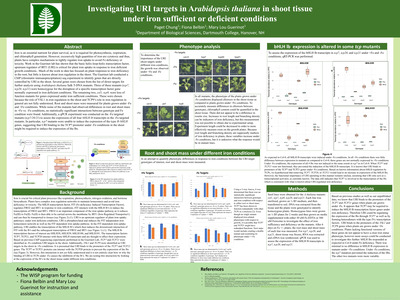
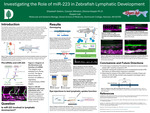
This poster presents a summary of research progress from Dartmouth's Women in Science Project (WISP) internship investigating the impact of the microRNA miR-223 on lymphatic development using zebrafish as a model organism. The lymphatic system, a complex network of vessels and organs that transport fluid throughout the body, plays a crucial role in supporting bodily functions including immune response and tissue fluid homeostasis. However, many aspects of lymphatic development are not well understood. MicroRNAs, small noncoding segments of RNA that regulate the expression of mRNAs, are crucial for regulating development processes. Previously, expression of the microRNA miR-223 has been found in lymphatic endothelial cells, suggesting the importance of miR-223 in regulating the lymphatic development. This in-progress study investigates the impact of a mutation of the microRNA miR-223 (cd87) on the development of lymphatic system.